

+44 (0) 1223 755950
+1 832 327 7413
Orders to United States ship from United States

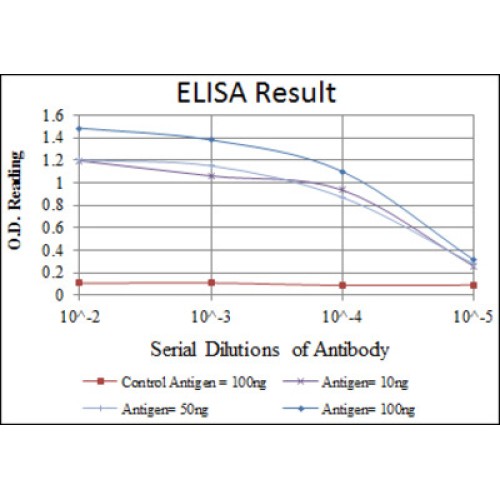
Click on the image to see the image legend
| Target | Nucleosome-Remodeling Factor Subunit BPTF (BPTF) |
| Clonality | Monoclonal |
| Reactivity | Human |
| Tested Applications | ELISA |
| Host | Mouse |
| Recommended dilutions | ELISA: 1/10000. Optimal dilutions/concentrations should be determined by the end user. |
| Conjugation | Unconjugated |
| Immunogen | Purified recombinant fragment of human BPTF expressed in E. coli. |
| Isotype | IgG2b |
| Form | Liquid |
| Purification | Unpurified ascites. |
| Storage | Aliquot and store at -20°C. Avoid repeated freeze/thaw cycles. |
| Shelf Life | 12 months. |
| UniProt Primary AC | Q12830 (UniProt, ExPASy) |
| UniProt Secondary AC | Q6NX67, Q7Z7D6, Q9UIG2 |
| UniProt Entry Name | BPTF_HUMAN |
| Gene Symbol | BPTF |
| GeneID | 2186 |
| OMIM | 601819 |
| HGNC | 3581 |
| KEGG | hsa:2186 |
| Ensembl | ENSG00000171634 |
| String | 9606.ENSP00000307208 |
| Molecular Weight | 338 kDa |
| Buffer | Ascitic fluid containing 0.03% sodium azide. |
| Concentration | Not determined. |
| Availability | Shipped within 5-10 working days. |
| Note | THIS PRODUCT IS FOR RESEARCH USE ONLY. NOT FOR USE IN DIAGNOSTIC, THERAPEUTIC OR COSMETIC PROCEDURES. NOT FOR HUMAN OR ANIMAL CONSUMPTION. |
 (
(