

+44 (0) 1223 755950
+1 832 327 7413
Orders to United States ship from United States
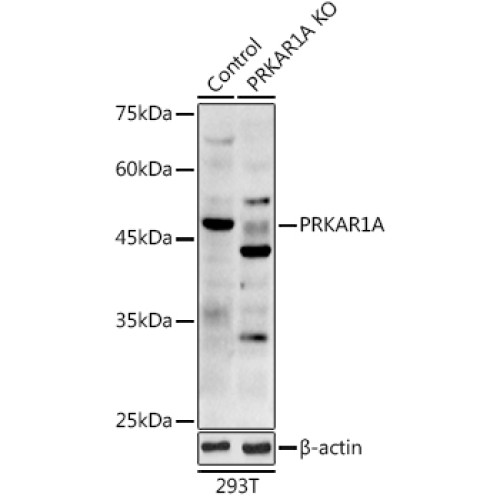
![Western blot analysis of various lysates using [KO Validated] PRKAR1A Antibody at 1/1000 dilution. Secondary antibody: HRP-conjugated Goat anti-Rabbit IgG (H+L) at 1/10000 dilution. Lysates/proteins: 25 µg per lane. Blocking buffer: 3% nonfat dry milk in TBST.](https://www.abbexa.com/image/cache/data/products/18B/abx000892_1-500x500.jpg "CAMP-Dependent Protein Kinase Type I-Alpha Regulatory Subunit (PRKAR1A) Antibody")
Click on the image to see the image legend
| Target | CAMP-Dependent Protein Kinase Type I-Alpha Regulatory Subunit (PRKAR1A) |
| Clonality | Polyclonal |
| Reactivity | Human, Mouse, Rat |
| Tested Applications | ELISA, WB, IF/ICC |
| Host | Rabbit |
| Recommended dilutions | ELISA: 1 µg/ml, WB: 1/500 - 1/1000, IF/ICC: 1/50 - 1/200. Optimal dilutions/concentrations should be determined by the end user. |
| Conjugation | Unconjugated |
| Immunogen | Recombinant protein corresponding to PRKAR1A. The exact sequence is proprietary. |
| Isotype | IgG |
| Form | Liquid |
| Purification | Purified by affinity chromatography. |
| Storage | Aliquot and store at -20°C. Avoid repeated freeze/thaw cycles. |
| Shelf Life | 12 months. |
| UniProt Primary AC | P10644 (UniProt, ExPASy) |
| UniProt Secondary AC | K7ER48, Q567S7 |
| UniProt Entry Name | KAP0_HUMAN |
| Gene Symbol | PRKAR1A |
| GeneID | 5573 |
| NCBI Accession | NP_002725.1 |
| KEGG | hsa:5573 |
| String | 9606.ENSP00000376475 |
| Molecular Weight | Calculated MW: 43 kDa Observed MW: 48 kDa |
| Buffer | PBS, pH 7.3, containing 0.02% sodium azide, 50% glycerol. |
| Concentration | > 0.2 mg/ml |
| Availability | Shipped within 5-10 working days. |
| Note | THIS PRODUCT IS FOR RESEARCH USE ONLY. NOT FOR USE IN DIAGNOSTIC, THERAPEUTIC OR COSMETIC PROCEDURES. NOT FOR HUMAN OR ANIMAL CONSUMPTION. |
 (
(